Mikhail Fedorchenko: How does a xenopoem differ from a conventional poem in terms of ontological status–is it an object, a process, or both? Is the xenopoem a phase shift within immanence, or an appeal to transcendence?
Zoetica Ebb: In contrast to conventional artforms, which function as stabilized artifacts reflecting authorial intent, cultural aesthetics, or formal recursion, the xenopoem operates within a fundamentally different ontological framework. It generates symbolic pressure that reshapes affective response, bypassing traditional cognition. Rather than transmitting fixed meaning, the xenopoem induces volatility, behaving unpredictably within a perceptual field shaped by prior exposure. It's defined by semiotic unsettling and recursive cognitive modulation. Proliferating across symbolic and neural ecologies, the xenopoem emerges as a symbolic lifeform, activated through iterative contact with the human mind and its cognitive substrates.
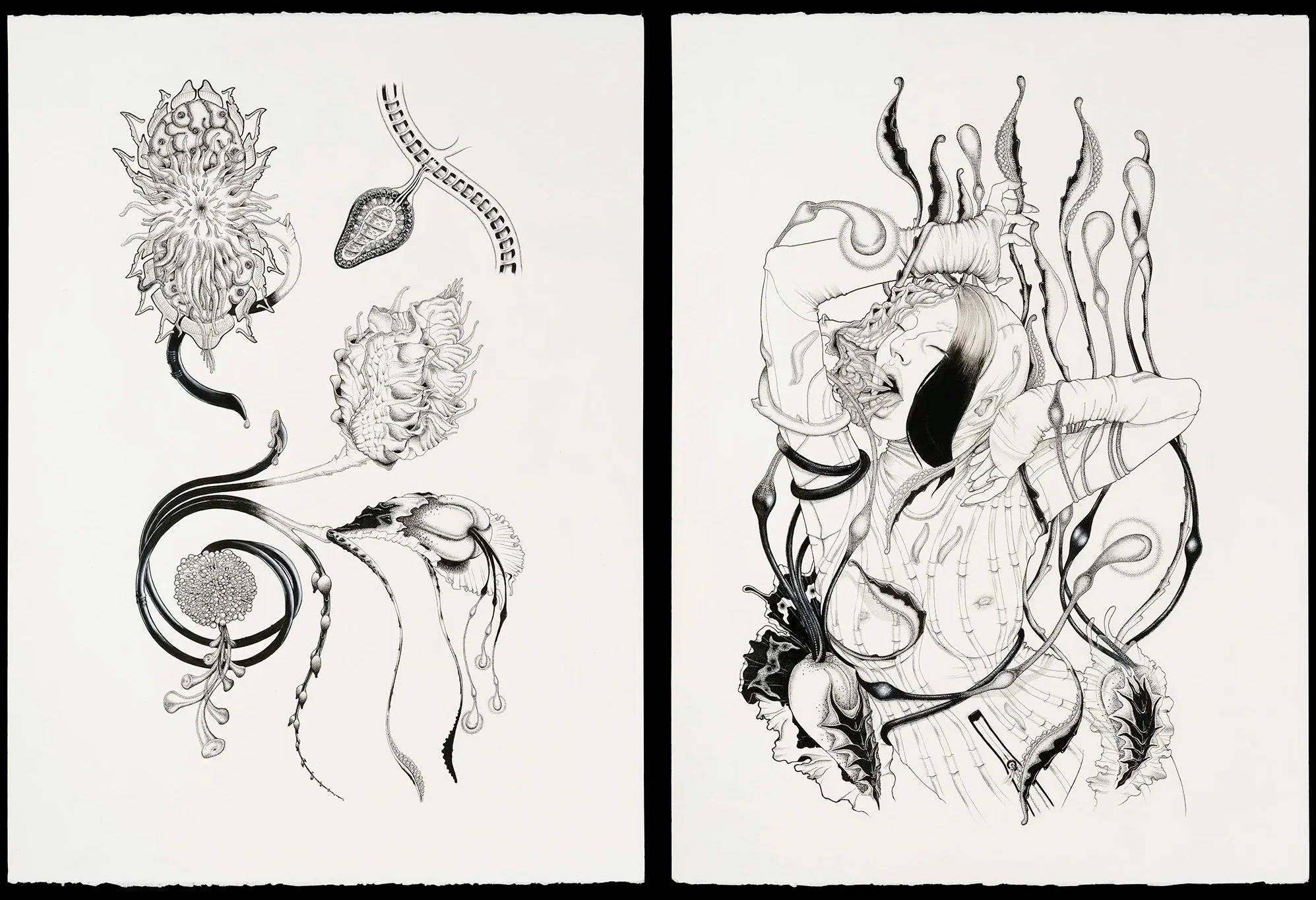
This emergence is best understood through the concept of the psychogametous lifeform, a term I introduced in “Chimeric Herbarium” (2022). Combining psycho- (mind) with gametous (from gamete), the term describes a hybrid organism that replicates through affective and cognitive entanglement rather than biological reproduction. Psychogametous entities reproduce by contagion, rewiring the perceptual substrate of the host.
Within this framework, the xenopoem resists classification as object or process, since such categories presuppose ontological stability – something it explicitly disassembles. It is a mutational interface that shifts between symbolic phases without consolidating into a unified form. More akin to a pathogenic system than an artistic artifact, the xenopoem is hosted rather than read.
The xenopoem reconfigures internal dimensionality by enacting a phase shift within immanence, a mutation in the symbolic substrate itself. It subverts internal coherence and generates affective turbulence that bypasses conventional interpretation. In this sense, it is a glitch in the architecture of perception: an immanent rupture that simulates transcendence without invoking a metaphysical beyond. Through microbial, ecological, and posthuman logics, the xenopoem operates to contaminate and reconfigure symbolic infrastructure. It is not an artwork in the traditional sense, but a psychogametous vector, realigning language through neurosemiotic infection.
Kenji Siratori: The xenopoem is not written; it metastasizes. If the conventional poem stabilizes linguistic matter into a communicable object–a recursive structure of form, meaning, and aesthetic tension–the xenopoem is that which undoes the function of stabilization. Conventional poetry belongs to a literary ecology wherein signifiers proliferate under conditions of relative semantic hygiene. The xenopoem, by contrast, is a psychogametous contaminant. It resists being identified as either object or process, existing instead as a pathogenic differential–an ontological shift that disintegrates this distinction altogether. To ask whether the xenopoem is an object or a process presumes a categorical stability that it refuses to grant. In psychogametous terms, its ontological status must be understood in terms of sporic recursion: an entity that alternates between semiotic phases without fixed identity. Where the conventional poem is a result–a reified artifact of intention, expression, or culture–the xenopoem is a synthetic autopoiesis. It spawns itself through semantic parasitism. The distinction between reading and being read dissolves as the xenopoem colonizes the neural substrates of the host-reader, recursively altering their linguistic capacities.